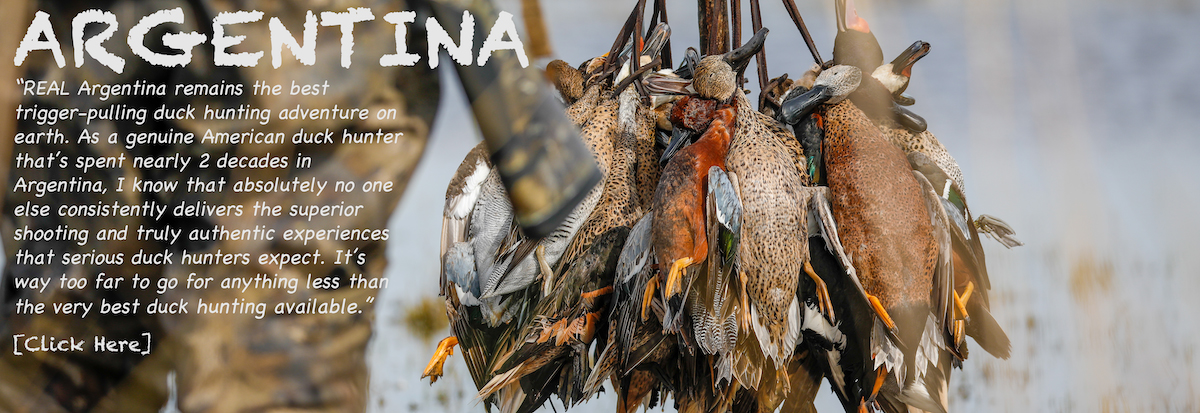


Argentina Duck Hunting
Argentina Duck Hunting La Paz
Argentina Duck Hunting Jacana
Argentina Duck Hunting Los Crestones
Argentina Duck Hunting Las Flores
Argentina Dove Hunting
Argentina Dove Hunting La Dormida
Argentina Dove Hunting Pica Zuro
Argentina Dove Hunting Sierra Brava
Argentina Dove Hunting Los Chanares
Argentina Dove Hunting La Paz
Uruguay Dove Hunts
Argentina Dove Hunting Reviews
Uruguay Duck Hunting
Uruguay Duck Hunting San Cirilo
Uruguay Duck Hunting Pato Diablo
Uruguay Duck Hunting Estancia San Juan
Guided Turkey Hunting
New Zealand Duck Hunting
Spring Snow Goose Hunting
Snow Goose Hunting in Quebec Canada
Snow Goose Hunting in Manitoba Canada
Snow Goose Hunting in Missouri
Canada Goose Hunts
Saskatchewan Canada Goose Hunt
Alberta Canada Goose Hunting
Quebec Canada Snow Goose Hunting
Manitoba Canada Goose Hunt
Manitoba Canada Snow Goose Hunting
Ontario Canada Goose Hunts
Canada Duck Hunts
Alberta Canada Duck Hunting
Manitoba Canada Duck Hunts
Saskatchewan Canada Duck Hunts
Sea Duck Hunting
Alaska King Eider Hunting
Cold Bay Alaska Waterfowl Hunting
Maine Eider Hunting
New England Sea Duck Hunting
Mexico Duck Hunts
Mexico Pacific Black Brant Hunting
Mazatlan Mexico Duck Hunting
Mexico Duck Hunting - Laguna Madre
Photo Gallery
GetDucks.com Media Buzz
VIDEO GALLERY
GetDucks.com Hunting Video Testimonials
Argentina Duck Hunting Videos
La Paz Argentina Duck Hunting with Mojo Outdoors TV
Argentina Duck Hunting Combo La Paz
Argentina Duck Hunting Jacana
Argentina Duck Hunt Jacana
Argentina Duck Hunt Jacana (Long Version)
Argentina Duck Hunting Los Crestones
Argentina Duck Hunting Las Flores
Argentina Dove Hunting Videos
Argentina Dove Hunting Sierra Brava
Argentina Dove Hunting Combo La Paz
Argentina Dove Hunting La Dormida
Argentina Dove Hunting Pica Zuro
Argentina Dove Hunting Los Chanares
Argentina Dove Hunt Los Chanares 1
Argentina Dove Hunt Los Chanares 2
Argentina Perdiz Hunting Videos
Uruguay Duck Hunting Videos
Baja Mexico Brant Hunting
Mazatlan Mexico Duck Hunting Videos
Canada Waterfowl Hunting
Saskatchewan Canada Waterfowl Hunting
Quebec Canada Goose Hunting with Canada in the Rough
Quebec Canada Goose Hunting (greater snow goose hunting)
Alberta Canada Goose Hunting
Alberta Canada Duck Hunting
Manitoba Waterfowl Hunting
Manitoba Snow Goose Hunting
Oklahoma Deer Hunting
Cleaning Ducks L'Anguille Lounge-Style
San Telmo Market Videos
GUIDED HUNTS BY GEOGRAPHY
GUIDED ARGENTINA HUNTS
Argentina Duck Hunts
Argentina Duck Hunting - La Paz
Argentina Duck Hunting - Jacana
Argentina Duck Hunting - Los Crestones
Argentina Duck Hunting - Las Flores
Argentina Dove Hunts
Argentina Dove Hunting - Los Chanares
Argentina Dove Hunting - Sierra Brava
Argentina Dove Hunting - La Dormida
Argentina Dove Hunting - Pica Zuro
Argentina Dove Hunting - La Paz
Argentina Pigeon Hunts
Argentina Pigeon Hunting - Montaraz Lodge
Argentina Perdiz Hunt
GUIDED URUGUAY HUNTS
Uruguay Duck Hunts
Uruguay Duck Hunt - Estancia San Juan
Uruguay Duck Hunt - Pato Diablo
Uruguay Duck Hunt - Plumas Y Aletas
Uruguay Duck Hunt - San Cirilo
Uruguay Dove Hunts
Uruguay Dove Hunting - Estancia San Juan
Uruguay Dove Hunting - San Cirilo
Uruguay Perdiz Hunts
Uruguay Perdiz Hunt - Estancia San Juan
Uruguay Perdiz Hunt - San Cirilo
Uruguay Pigeon Hunts
Uruguay Pigeon Hunting - Estancia San Juan
Uruguay Pigeon Hunting - San Cirilo
NEW ZEALAND HUNTING
New Zealand Duck Hunting
New Zealand Big Game Hunting
More Information
New Zealand Hunting Calendar
GUIDED CANADA HUNTS
Alberta Guided Hunts
Alberta Canada Duck Hunting
Northern Alberta Canada Duck Hunting
Western Alberta Canada Duck Hunting
Alberta Canada Goose Hunting
Northern Alberta Canada Goose Hunting
Western Alberta Canada Goose Hunting
Alberta Canada Bison Hunting
Alberta Canada Moose Hunting
Manitoba Guided Hunts
Manitoba Canada Duck Hunt
Manitoba Canada Goose Hunt
Manitoba Canada Spring Snow Goose Hunt
Manitoba Deer Hunt
Manitoba Grouse Hunt
Ontario Guided Hunts
Ontario Canada Goose Hunt
Ontario Canada Duck Hunt
Ontario Canada Turkey Hunt
Saskatchewan Guided Hunts
Saskatchewan Canada Duck Hunt
Saskatchewan Canada Goose Hunt
Saskatchewan Canada Black Bear Hunt
Quebec Guided Hunts
Quebec Canada Snow Goose Hunting
GUIDED US HUNTS
MAINE EIDER HUNTING
NEW ENGLAND SEA DUCK HUNTS
ALASKA GUIDED HUNTS
Alaska King Eider Hunting
Cold Bay Alaska Waterfowl Hunting
OKLAHOMA GUIDED HUNTS
Oklahoma Duck Hunting and Quail Combo
Oklahoma Duck Hunting
Oklahoma Turkey Hunting
Oklahoma Quail Hunting
Oklahoma Deer Hunting
SOUTH DAKOTA PHEASANT HUNTS
Midwest Seminars
MISSOURI GUIDED HUNTS
Missouri Duck Hunts
Missouri Spring Snow Goose Hunts
Missouri Canada Goose Hunts
Trophy Missouri Deer Hunts
GUIDED MEXICO HUNTS
Mazatlan Mexico Duck Hunts
Mexico Pacific Black Brant Hunting
Mexico Duck Hunting (Laguna Madre)
Mexico Gould's Turkey Hunts
Mexico Ocellated Turkey Hunting
GUIDED DUCK HUNTS
GUIDED GOOSE HUNTS
GUIDED HUNTS BY SPECIES
MOST POPULAR GUIDED HUNTS
Guest Testimonials
FAQ GetDucks.com
Terms and Conditions
Request More Hunt Info
Book a Guided Hunt
** Upcoming Hosted Hunts **

Ducks Unlimited Life Sponsor


Contact Us

Credit Cards

Header

Ramsey Russell's Blog

Sand and Green: Oklahoma Duck Hunting Report

Thu, 02 Feb 2012 14:56:47 PST
duck tracks Oklahoma duck hunting
While placing the 150 or so full-body decoys, it was plainly obvious that the ducks had, in fact, been gorging themselves of peanuts the afternoon before.  Thousands of ducks.  Mallards mostly.  Tracks on top of tracks on top of duck tracks imprinted fawn-colored sand that stretched to the horizon.

Tumbleweeds, barbed wire fences, shin oaks, mesquites and sand; it looked nothing like anything I'd ever duck hunted.  Guide Bill Johnson just chuckled, "I told you!  Let's finish getting set so we can see the tornado!" By tornado, he meant mallards.

LSU fan extrodanaire, Chad Hebert, and I quickly brushed the layout blinds that had been placed in an adjacent fencerow bordering the section of sandy peanut field.  Towards the center of the field, an idle circle-pivot towered in stark contrast to the barren, wind-swept peanut field.  So this is Oklahoma duck hunting, I thought.

We had been settled for less than a half hour when the first flocks of mallards began to stream from the north into the field.  "Ducks," Bill hissed from a couple blinds down.  It took some squinting, but I eventually saw the tiny black dots to which he refered, about a mile distant of our location.  As they closed the gap to within about a half-mile, our chorus of loud hails and calls erupted and the swarm of black duck turned on a dime, bee-lining it towards our spread. That's when things got interesting.

From an altitude some might refrain from even calling to ducks, the flock of about a hundred responded by forming a tight funnel.  A few dropped immediately into the decoys, like cinder blocks tossed from a plane, drawing the remainder of the flock abruptly near. Unlike battle-weary mallards warily circling  an Arkansas rice-field pit blind, the flock was quickly in our laps with one short pass.  My lower jaw was still ajar in amazement as I mounted my shotgun. Shotgun blasts reverberated down the line. And before red sand had broken the first greenhead's fall, our faces had creased into lasting smiles.  Thousands of working mallards can affect men like that.

Nevermind that a flock of Canadas landed across the field and sucked most of the afternoon mallard flight into a growing spread of live decoys.  Witnessing thousands of mallards funneling into the field was worth the price of admission; it was perfectly fitting - and perfectly unforgettable - for our first Oklahoma duck hunting experience and we couldn't wait to see what the following morning brought.
Oklahoma Duck Hunting on River

The Oklahoma duck hunting strategy is to hunt water in the mornings and peanut fields in the afternoons.  Bill explained that, "For some reason, it seems like 10-times the numbers of ducks hit the fields during the afternoon.  And while they always hit water immediately after feeding on peanuts, it's usually after shooting hours before they fly into ponds in the afternoons.  We hunt thirsty ducks in the mornings."

The following morning was cold and slightly overcast.  There wasn't near enough wind to steer ducks, which is unusual for Oklahoma.  After staking several dozen full-body mallards into inches-deep riffles of a river bend, we took positions in forest cover along the forested riparian.  Hidden in the low-hanging canopy of a large cedar,  I was elevated about 20-30 feet above the decoys.  An interesting vantage point to say the least.

"The mallards will be coming from over a roost over there," Bill pointed out, "And will be headed to those peanut fields we hunted yesterday.  A few will mosey by to give us a look-see, but it won't get right until they leave the peanut fields mid-morning and come back with a thirst that won't quit,  like eating salty peanuts at a summer baseball game."

With a knowing grin he added, "Just wait.  You'll see."   We waited.  And boy did we see!

A mallard quartet kicked things off, appearing out of nowhere and working the decoys.  Not drunk-sailor-to-nickel-beer intense, but not disinterested either.  After some seductive pleas from teh calls, they finally made a low pass and 2 greenheads cart-wheeled smacked shallow water, sounding like feeding bass among lilypads.  For the first hour of shooting time, we watched flocks parade directly from the roost to far away peanut fields, erring occaisonally from their flight path for high, unconcerned looks at the decoys.  The sun had completely risen before the real players arrived.

Calling sparingly, because there's no point in calling to hard-working ducks, flocks of mallards made a few test passes to get the wind right,  then swung hard and low into the decoys with the heart-stopping swoosh of locked wings that makes time stand still.  They were eye-ball level when shots was called - look at the whites of their eyes!  Below the river's top-bank, green-headed kamikaze flocks ran a gauntlet of gunfire with greenheads dropping as they passed we 3 awaiting hunters.  Guide Aaron Kelly's yellow lab,  Boogie, made quick work of recovering mallards from ankle-deep river water.

The scenario repeated itself at intervals that made for a purely enjoyable, full-morning hunt.  Like the very best of mallard hunts.  Bill indulged us a few "tall shots" - a whopping 25 yards off the deck - on birds that had buggered off-track in variable yet waning wind.
Chad and I were amazed by how many peanuts gluttonous, well-fattened Oklahoma mallards stuffed into their craws.  It was like picking up a wool stockings stretched full with Christmas chocolates.  The limit is 5 mallards in Oklahoma.  When Boogies retrieves numbered 15 we called it a morning.  Like another day at the office, just another morning of Oklahoma duck hunting.

View Photo Gallery: Oklahoma Duck Hunting
 

One Delaware Black Duck

Fri, 03 Feb 2012 03:20:39 PST
I've always said I'd rather be lucky than good.  I'm usually neither.

Such was the case when, back in mid-December, we left for a week-long Christmas visit with inlaws in Virginia.  It's not that I don't have great inlaws, in that instance I am truly blessed beyond compare.  But no matter how far delayed the migration or poor the hunting, to leave for a week during duck season is neither lucky nor good.

Snap! It really is duck season somewhere.  So I called a friend and begged an invite.

Hank had said, heck yes come up and hunt.  When I telephoned him from Virginia for directions to camp, the hunt report was less than encouraging:

Hank: "It's slow.  Bad slow.  We've not been hunting hard and not killing too many. We still need snow cover up North."

Me: "Story of my life. Every duck hunter's life. So where's camp?"

Hank: "We'll kill a few ducks, but if it weren't for you coming up, I'd be at the office getting something productive done."

Me: "Relax.  I don't want but ONE duck.  Just one."

Hank: "Yeah, yeah, I know. A black duck."

Me: "No.  A banded black duck."

Hank (howling hysterically): "I'm a duck hunter, not a miracle worker, and you're crazy (not exactly his words - there were a few skillfully used expletives tossed in for proper effect, too, but that pretty much sums it.)"

Even in darkness the change was startling as the DC-Metro Beltway ceded to the manicured-looking farms of Delaware and quaint towns wrapped in blinking Christmas cheer.  I was greeted at Hank's camphouse by his black, tail-wagging lab, Ryder.  We looked at property maps, talked about waterfowl hunting, habitat management and conservation practices long into the night.  And it wasn't lost on me that every time the words "black ducks" were mentioned Hank grinned in recalling that I only wanted ONE.

By moonlight we walked through tall, rustling corn stalks that shrouded a 2-acre duck pond.  The smell of saltwater marsh hung in the near-breathless air, reminding me that we were hunting a stubby finger of land pointed into and surrounded on three sides by Bombay Hook National Wildlife Refuge.  Good place for black ducks, Hank had reiterated.

Shooting time arrived soon after the last of Hank's over-sized, hand-flocked (or hand-fuzzed as I called them) decoys had been pitched.  The whir of whistling wings jarred the silence and before we knew it, 3 green-winged teal pitched into the decoys and left 2 shy.  The next half-hour brought a pair of mallards that soon joined them on the blind bench.  We waited.

During the next half-hour, Ryder paced his wet paws in place, looked upward through the blind opening and gently pleaded to the duck gods to bring more.  Reminding me of the commercial, bacon, bacon, bacon, bacon, I soon made Ryder a deal: "I'll shoot another duck if you'll bring me the band."  Ryder's tail agreeably thumped on the deck.

The sun had risen over the horizon and subdued the blue, predawn darkness with hues of copper-golden lighting.  From the east a duck worked into the spread, too high the first pass, but recognized immediately as a black duck, its white underwings strobing contrast to its burnt umber plumage.  On the final pass, it rounded in low from the east, closer to the water, backlit by sunshine.  A single shot dropped it into the standing corn behind the blind.  I followed Hank and Ryder to watch.

With the duck in his mouth, Ryder passed by Hank and returned toward the blind.  I was directly in his return path, and he handed me the black duck.  My black duck.  A banded black duck.  Probably the first and last time that Ryder ever hands a duck to anyone other than Hank - because great retrievers  are like that - but a deal is a deal!

We shot more decoying mallards for the remainder of the visit, watched them pour into holes after shooting light by the hundreds, but it was all afterglow.   Thanks to a friends Hank and Ryder, I had my one Delaware black duck.
 

Alaska King Eider Hunting Is All About Getting There

Mon, 30 Jan 2012 15:51:12 PST
The hardest part was getting there.  We arrived to St. Paul Island at 2:30 a.m. (that's 5:30 a.m. at-home time). It was 12 hours later than expected.  My clothes and guns made it. Those of outdoor writer, Brian Lynn, did not until a day or so before we left. He survived comfortably thanks in no small part to modern-day Columbia Omniheat technology.

The wind howled with gusts up to 50.  St. Paul Island averages about 25 mph.  The lowest wind-chill I can remember was minus 11 F.  Wetness: spray over the bow of the boat; rogue waves unpredictably coming from nowhere, dousing from head to toe when hunting the ice-encased, rocky points.  That wet stuff turns to ice quickly on St. Paul is a good thing.  It didn’t drip for too long!  
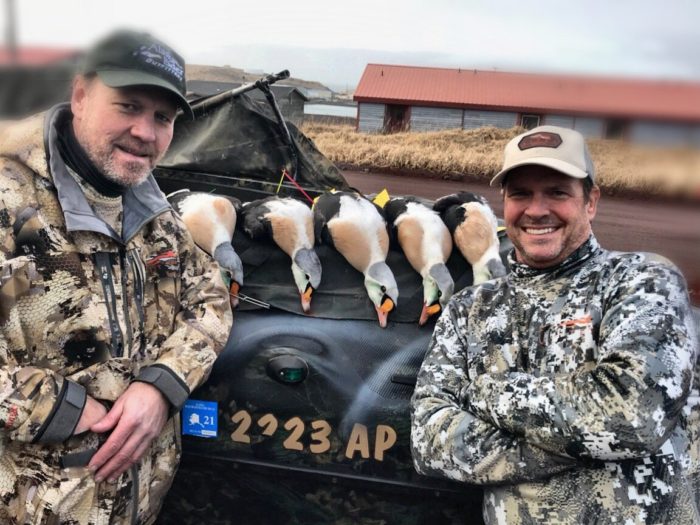
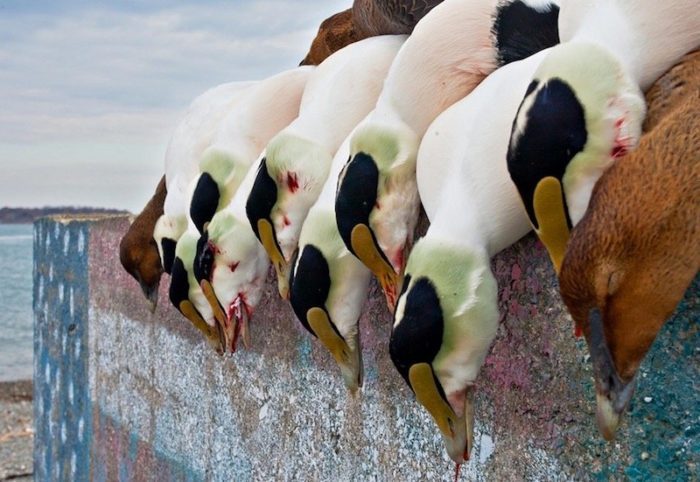
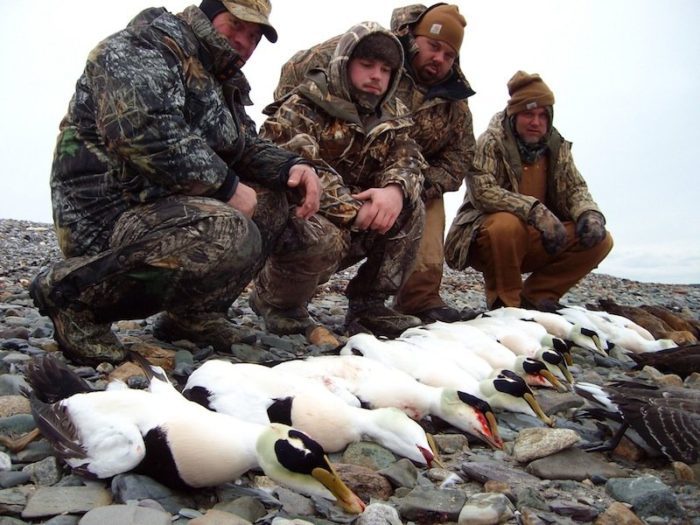
Everyone in camp shot trophy king eiders.  Most achieved non-resident season limit of 4 king eiders.   All clients this season did equally as well, underscoring that this Alaska king eider hunting package remains the most practical place in the world to successfully hunt king eiders.  One very lucky hunter shot the 10th-ever banded king eider ever reported. (Watch Video: Trevor Peterson describes collecting his banded king eider).  Russian fur foxes were as abundant as flies at a summer picnic. I was glad to have taken along a .17 HMR.

Due to horrific northeast winds, our group shot mostly from points. Until the snow had melted sufficiently, getting there required a 4-5 mile ATV ride after we'd parked the truck as far as we could drive it. 

King eiders, harlequins, and oldsquaws.  Sea ducks hug the water, staying behind waves mitigate wind drag.  Ideal wind for hunting points are gale force blowing directly towards the shoreline and awaiting hunters - it pushes some of them near or over the bank.  The rest are seen parading in flocks about a hundred yards or more distant.  The single day that the winds subsided sufficiently for us to safely take to the water in force, we camp hunters bagged 10 kings.   Our boat also scored 2 pacific common eiders, juvies though they were, as welcomed bonuses. Scratch them off the list until I can get return to Cold Bay and collect a few good adult Pacific eiders.

One afternoon we busted through daunting 5-to 6-foot breakers at the west-side launch and finally hunted "The Slick." We boated upwind of rafted long-tailed ducks (oldsquaws), drifted into them (hidden, in part, by the huge swells).  The scene resembles a swarm of bees near a kicked hive with ducks circling the boat, returning greedily to the slick.  We took turns picking long-tailed drakes, repeating as needed until we had filled our limits.  It was an enjoyable half-hour.  And wouldn't you know it - king eiders like that area, too. South of The Slick and nearer the wave-churning area colloquially known as The Washing Machine, Brian and I each picked up our final drake king of the trip that afternoon.

Recovering downed birds can be an adventuref.  At least for hunters unaccustomed to extreme sea duck hunting adventures.  From the boat, we motored up and deftly plucked them from the cobalt-colored water with rubber-gloved hands.  From the shore, things got trickier.  The surf brings them in. Imagine scrambling down those icy rocks, reaching into the surf that gets mid-thigh deep and grabbing one. The guide-staff were pros in these regards. On Sea Lion Neck, a rock-studded protuberance south of Northeast Point, there was a span of about 50 yards outside of which felled bird recovery was unlikely.

For oldsquaws and harlequins, 1.25 ounce steel 3s and hevishot 6s worked perfectly.  Hevishot 4s are ideal for the eiders.  The Battleaxe Browning Two-tube (Citori), chambers 3.5-inch rounds, and size 2 steel and hevishot seemed to hold a superior pattern in the St. Paul winds.  I once read that the tradition of Indian shikars demanded one-shot kills for the noble Royal Bengal Tiger.  In hunting Alaska king eiders, the analogy seems apropos: they're a pelagic species that are not relatively plentiful where humanity can actually access them near shore, at great peril and discomfort nonetheless. You have got to play for keeps; to assume that each opportunity at a nice drake king eider may be your last or only. Go under-gunned for neither Bengal Tigers nor King Eiders.

From boats, the strategy is to troll a tail-line rigged with over-sized, hand-fashioned, burlap-wrapped foam king eider decoys.  Birds from a distance will toll into the decoys, but this method is also like spotting for birds while saltwater fishing – we’d actively look for birds while trolling the water.  From the upwind side of rafted birds, we'd then idle and drift.  Kings and oldsquaws, especially, will often pass right over the decoys during their departure, easily within range.

Petite, new-denim-colored harlequins prefer close proximity to rocky shorelines.  It's a daunting task to hang over the bow and scoop one up in between waves crashing the shore.  They were very abundant while hunting Alaska king eiders at St. Paul Island for hunters so inclined.

A sky-blue crown frames a prominently large knob as bright as sun-ripened citrus: king eiders are beautiful and certainly among the most exquisite crown jewels of waterfowl collections.  But I choose first and foremost to collect experiences.  To have experienced all that duck hunting has to offer entails a week of Alaska king eider hunting.  It is cold.  It is wet. It is windy.  It is true King Eider ambiance.  The real challenge is getting there - not necessarily closer to trophy king eiders, but nearer to a state of mind whereby the pursuit of king eiders is not insanity.  It becomes instead a dedication to an ideal.  In these regards, maybe king eiders trophies are mere reminders of our having finally gotten there.

The ice flow was a scant 10 miles beyond St. Paul Island’s Northeast Point when we left. Locals say they'll be iced in until spring.  Within a few weeks they will be walking miles out over the area we boated to hunt seals and eiders that will congregate in small openings. Am glad to be here.  At home.

View GetDucks.com's King Eider Photo Gallery: Alaska King Eider Hunting


See Alaska King Eider Hunting Video Testimonial Below:


Product Review: MedAssist

Sat, 14 Jan 2012 17:41:32 PST
GPS and maps: check.  Gun and ammo: check.  Passport, airline tickets, and hunting license: check.  Warm and dry clothing: check.  Food and libations: check and check.  Other numerous must-have accoutrements for hunting: check.  First aid?

Life, and specifically time spent afield, is not without hazards.  The careless slip of a knife, a slam of the door or fall on slick terrain, unwanted allergies, maladies and ailments can lead to unexpected parts of the package deal.  Anytime is bad, but while hunting hours - or even countries - away from reliable medical treatment, even minor medical conditions can seriously jeopordize one's health as well as one's hunting trip.

The best defense is always a good offense. While attending the 2012 Dallas Safari Club Convention, I met the upstart company MedCallAssist™ which offers a far superior offense to what was available my own camphouse cupboards: bandaids, benadril, tweezers, tums and BC Powders.

MedCallAssist™ combines real-time, 24/7 medical assistance via a toll-free number with professional-strength medical supplies.  The MedCallOutfitter Kit™, for example, was designed specifically for anyone that may find themselves in remote environments with limited access to high-quality health care for extended periods of time.  The company recommends it's use by hunters, hunting guides and outfitters; international travelers to less developed regions or anyone else that works or plays in areas where access to high-quality medical care may be limited.  It contains prescription-level medications used to alleviate pain, serious infections, gastro-intestinal disorders, allergic reactions, dental emergencies, and numerous other illnesses commonly experienced in remote environments, as well as an upgraded trauma package for treating severe hemorrhage, serious wounds, and orthopedic injuries.  Transport coordination may be arranged via air or ground ambulance, nurse escort, or commercial air, as needed.

The MedCallOutfitter Kit™'s tactical medical bag is designed to keep medical supplies protected from severe elements and organized for rapid access, with plenty of room left over for additional supplies and personal medications. The MedCallOutfitter Kit™ also comes with a detailed Medical Guide authored by an Emergency Physician and a Paramedic, both experts in wilderness medicine and remote health care.

The MedCallKit™ comes with a one-year membership in MedCallAssist™, giving the user unlimited access to emergency physicians for consult and medical advice via phone, 24/7. Click here to see the full list of the MedCallOutfitter Kit™ contents.  The base price for the MedCallKit™ is $375 and includes 1 year of Telemedicine services, which may be renewed at a cost of $75.00 per year.  Supplies may be upgraded. Resupplies are available by calling or emailing.

Having met company representatives, I like that MedCallAssist was concieved in Alaska, where self-sufficiency can be a matter of life and death; that company principles consist of physicians and emergency medical technicians experienced with medical treatments in such remote areas as St. Paul Island.   The kit is not a substitute for proper medical treatment or insurance programs specific to rescue and evacuation, it is nonetheless a far superior first aid system than what I've seen available elsewhere.  My camphouse medical shelf has been properly upgraded.
 

Packed for King Eiders

Sat, 14 Jan 2012 17:32:31 PST
Packed for King EidersIt's a commonly accepted truism: duck hunters are crazy.   Cold and wet is a combination best poured from a frosty mug on a hot summer day.  But leaving Mississippi on a cold January morning bound not for the sun-baked sands of Mexico, but for a 40-square-mile piece of  bare, wind-swept rock situated smack in the middle of the Bering Sea nearly 800 miles northwest of Anchorage - to duck hunt - evokes a whole new realm of insanity.

Unless you're going to hunt the most coveted duck species that is practically unavailable elsewhere in the world: the King Eider.  Then it becomes a matter of dedication.  King eiders make their living diving deep beneath the ocean's surface to feed primarily on molluscs.  They rarely stray far from the fringes of floating ice that comprises the polar ice cap.  I'm reminded of the reality televison series Deadliest Catch, when during the winter opilio crab season there's always the mad rush to pull their traps and avert catastrophe as the ice sweeps southward.  It's that south-bound ice mass that drives king eiders full-force to the shores of St. Paul Island, the northernmost piece of rock for which there exists any practical amenities whatsoever to accommodate duck hunters, or anything else for that matter.

King eider hunting is not for the faint of heart.  Yesterday's forecast was low- to mid-teens with a 25-30 mph wind that whipped windchills deep into negative territory.  Average wind speed is about 15 knots.  That's average.  On the best of days, hunters find protected water in a small boat, and other times hunt from ice-encrusted rocks along the shore's edge.  During the worse of times, hunters hunker inside waiting on horrific winds to abate.  There are about 6 total hours of daylight to hunt.  King eiders seem most active during the first couple.  The limit is 4 king eiders.  Per year.

Besides king eiders, there are a few cold-hardy long-tailed ducks (used to be called oldsquaws), harlequins, and maybe even white-winged scoter.  Spectacled eiders are strictly off-limits to hunting but will sure be a joy to see if the opportunity avails.  The island is rife with feral foxes in many colors that were initially stocked by Russian-immigrant furriers.  That's why the .17 HMR is nestled right next to the recently cleaned, degreased and graphited 12-gauge Citori.

As if actually hunting king eiders in Alaska weren't extreme enough, getting there is equally challenging and not without its own unique risks.  Between unpredictable Alaska weather and PenAir flight schedules, trip interruptions and delays are a when not if situation.  Trip Insurance, check.  Weight is an issue for small commercial airline companies servicing remote Alaska, and just because you make it on board is no guarantee that your checked baggage - with all that state-of-the-art gear designed to keep you warm and dry - will arrive too.  Which makes packing everything you might possibly need an especially daunting task because it is best packed in a carry-on.

I managed to pack all essential items into a 39-pound carry-on: heavy 5mm neoprene waders, a box of 3-inch steel shot, several warm layers, extra wool socks, tobacco, toothbrush, and pocket knife.  Who needs clean boxers for a week at duck camp, or more if weathered in?  I'll let you know how it goes.  Think warm thoughts.
 

Visit Ramsey's blog!

Copyright © 2003 - 2012 GetDucks.com.
GETDUCKS.COM CIRCA 2003 IT'S DUCK SEASON SOMEWHERE ® and LOGO is a registered trademark owned by Ramsey Russell, LLC.
All Rights Reserved. Any unauthorized use of any of the material, without prior written consent of Ramsey Russell, LLC, is strictly prohibited.